Asking whether a few simple facts about a patient’s past hospital use, known the moment they are admitted, can predict who will be readmitted within 30 days as well as far richer clinical data, using the public MIMIC-IV dataset.
Research
My research sits at the intersection of machine learning and healthcare. I work with complex health records to build useful predictions, design tools that help clinicians understand patient histories, and explore how language models can support care. I care about work that is technically sound, understandable to the people using it, and grounded in how healthcare actually works. This page brings together my current work, publications, posters, and earlier projects.
Publications and posters
- Verma S, Parkes MD, Davis SM, Ezekowitz M, Mitchell JR. Patient Record Visualization and Predicted Readmission Risk in Inflammatory Bowel Disease. Poster Presented at: 59th Annual Summer Students’ Research Day, University of Alberta Faculty of Medicine & Dentistry. 2026 Aug 21; Edmonton AB.
- Vaid S, Weldon M, Dunn J, Davis S, Lonergan K, Li H, Franc J, Dervishi E, Abdalla M, Baumgart DC, Hayward J, Mitchell JR. Berta, an Open-Source, Modular AI Scribe for Clinical Documentation: Implementation Report. JMIR Medical Informatics. 2026 Nov 10;14:e105385. [doi]
- Parkes M, Greiner R, Davis SM, Mitchell JR. Assessing the Value of Long-Range Medical Record Timeseries for Predicting ICU Stay Outcomes With Transformers. Preprint. JMIR Preprints. 2026 Jul 29. [doi]
- Davis S, Greiner R. Survival models and longitudinal medical events for hospital readmission forecasting. BMC Health Services Research. 2024 Nov 13;24(1):1394. [doi]
- Kumar N, Skubleny D, Parkes M, Verma R, Davis S, Kumar L, Aissiou A, Greiner R. Learning Individual Survival Models from PanCancer Whole Transcriptome Data. Clinical Cancer Research. 2023 Oct 2;29(19):3924-3936. [doi]
- Davis S, Greiner R. Improving Hospital Readmission Prediction with Longitudinal Medical Histories and Survival Targets. Poster Presented at: Upper Bound Conference, Alberta Machine Intelligence Institute. 2023 May 24; Edmonton AB.
- Davis S, Zhang J, Lee I, Rezaei M, Greiner R, McAlister FA, Padwal R. Reading You Like a Book: Aggregated Medical Code Embeddings for Predicting Hospital Readmissions. Poster Presented at: Reverse Expo, University of Alberta. 2023 Feb 24; Edmonton AB.
- Davis S, Zhang J, Lee I, Rezaei M, Greiner R, McAlister FA, Padwal R. Effective hospital readmission prediction models using machine-learned features. BMC Health Services Research. 2022 Nov 24;22(1):1415. [doi]
- Davis S, Aissiou A, Kumar L, Lee L, Greiner R. Medical Topic Modeling using dLDA on mRNA-Seq Multi-Cancer Datasets. Poster Presented at: The Global Women in Data Science (WiDS) Conference at the Centre for Health Informatics, Cumming School of Medicine. 2020 Mar 3; Calgary AB.
- Haider H, Hoehn B, Davis S, Greiner R. Effective Ways to Build and Evaluate Individual Survival Distributions. Journal of Machine Learning Research. 2020 Jan 1;21(85):1-63.
- Aissiou A, Davis S, Kumar L, Lee L, Greiner R. Finding Gene Expression Patterns and Making Predictions for Cancers using Machine Learning. Poster Presented at: Excellence in Medical Student Research, A Collection of 2019 Medical Student Research from the University of Alberta. 2019 Nov 26; Edmonton AB.
My M.Sc. thesis is Learning Individual Readmission-Free Survival Distributions using Longitudinal Medical Events [Dissertation].
Current research projects
With clinical teams at the Precision Health AI Research (PHAIR) Lab, Department of Medicine, University of Alberta.
Hospital medicine Forecasting hospital readmissions
Paper in progress
Nephrology Predicting adverse kidney outcomes
Paper under review
Asking whether machine learning on electronic health records can beat a simple clinical score at predicting which survivors of acute kidney injury will go on to advanced chronic kidney disease, to help decide who to refer to nephrology at discharge.
IBD Rural and urban differences in IBD medications
Ongoing
Looking at whether people with inflammatory bowel disease in rural Alberta receive different medications from those in cities, and where better access to specialist care might matter most.
IBD Labelling periods of IBD disease activity
Implementation report in progress
An open-source web tool for reviewing a patient’s visits, tests, prescriptions and hospital stays on one interactive timeline, and labelling month by month whether their IBD was flaring, so the labels can be used in later research.
Rheumatology ChatRheum
Two papers in progress
A chatbot that answers patients’ rheumatology questions using trusted patient materials, evaluated with rheumatologists and patients and tested for safety.
Clinical trials Human-centred design for trial enrolment
Ongoing
The first phase of a project to build a privacy-preserving AI tool that runs inside the health system and helps match patients to clinical trials. Before designing anything, we are observing and interviewing the research coordinators who screen patients for trials in Alberta and the US, to understand how the work is really done today.
Past projects
Research and applied work
2025–2026
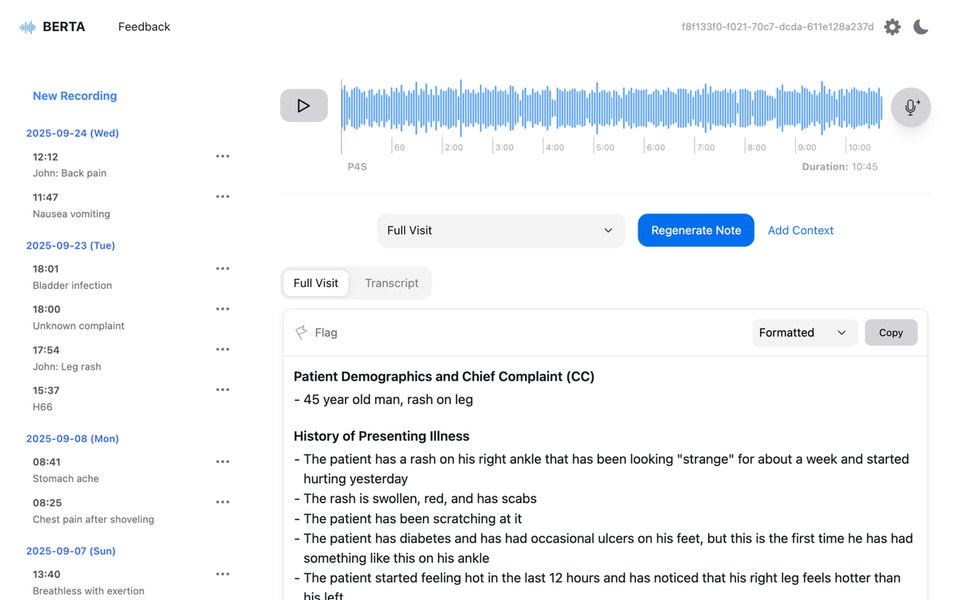
Berta: an open-source AI scribe for clinical documentation
An open-source, modular AI scribe. A clinician records a patient encounter, speech recognition transcribes it, and a large language model drafts a structured note for them to review and edit. In a 9-month pilot at Alberta Health Services, 197 emergency physicians at 105 urban and rural sites used it for over 21,000 sessions, at under US $30 per physician per month, with all audio and text kept inside AHS infrastructure. I co-authored the implementation report, helping shape its writing and narrative. The picture is the interface from the paper, showing a simulated patient. [JMIR Medical Informatics] [GitHub]
2025–2026
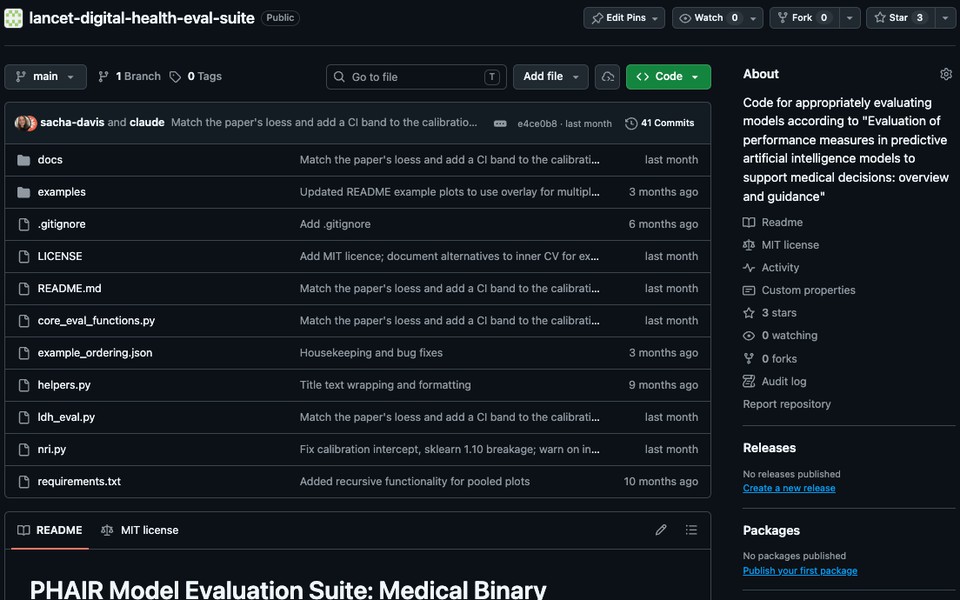
An evaluation suite for clinical prediction models
Which numbers to report for a clinical prediction model is contested. This open-source Python tool follows the expert consensus in Van Calster et al.’s 2025 Lancet Digital Health paper, so the choice has a defensible, citable rationale. Given predicted probabilities and true outcomes, it produces the four essential plots: the ROC curve, a loess calibration curve, a decision curve showing net benefit across thresholds, and risk distributions by outcome. It works across cross-validation folds and compares several models in overlay plots, with optional recalibration, bootstrap confidence intervals that account for patients contributing several rows, and corrected tests between models. [GitHub]
2024
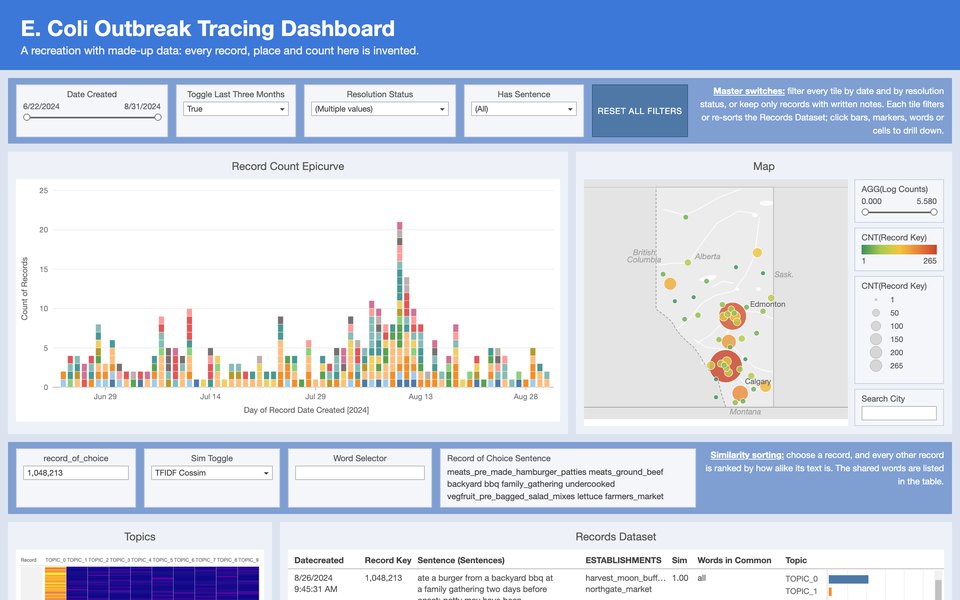
Tracing E. coli outbreaks through case notes
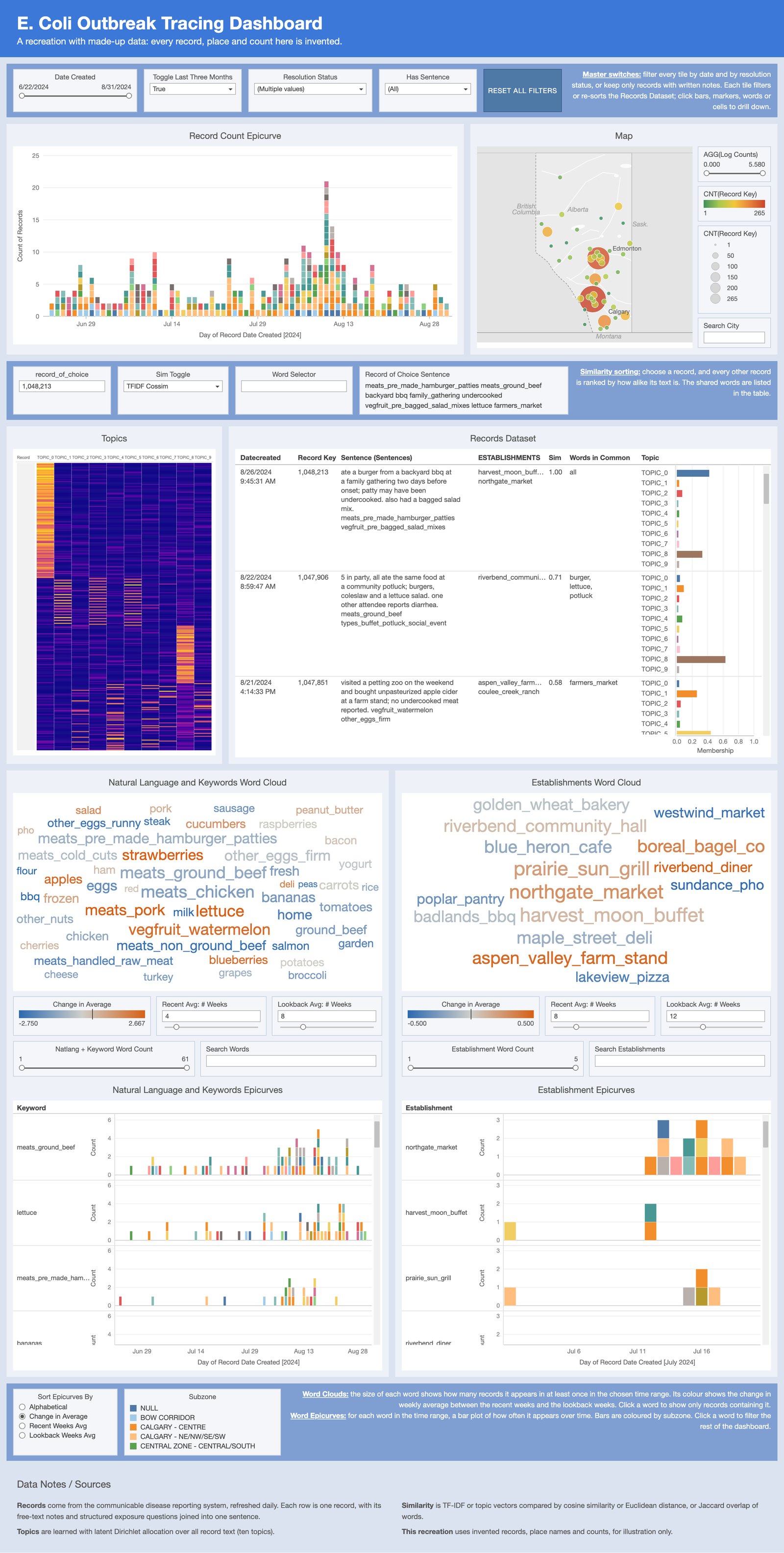
As a machine learning consultant for the Provincial Population and Public Health Division at Alberta Health Services, I prototyped and built a Tableau dashboard to help analysts find links between E. coli cases. It reads the free-text notes from case interviews, groups them into topics with latent Dirichlet allocation, and ranks every case by how similar its notes are to one the analyst picks. Word clouds and epicurves show which foods and establishments are coming up more often than usual, by week and by subzone. [Dashboard, recreated with made-up data]
2022-2023
Learning Individual Readmission-Free Survival Distributions using Longitudinal Medical Events
I use Neural Multi-Task Logistic Regression (N-MTLR) to model all-cause readmission-free survival as a function of time. N-MTLR, despite producing probability predictions for all future time-points, out-performs XGBoost and Deep Learning approaches trained specifically to predict readmissions at 30 days. Further, I show that N-MTLR, augmented with a sequence model, can learn a patient’s representation directly from their history of medical codes, predicting all-cause readmission with an AUROC of 0.846 using only sequences of historical medical codes as input. This approach significantly outperforms the LACE baseline, common in hospital settings.
2021-2022
Deep Learning for Crop Gene Expression Prediction from Sequence Data
Recent changes in global climate patterns (such as extreme average temperatures, droughts, and floods) have made the yields of Canadian farming methods much more unpredictable. Given these trends, scientists have taken to examining another major factor that can affect the success of a growing season: the genetics of the crop organism. To what extent can we predict gene expression changes driven by DNA sequences in Canadian protein crop species? To explore this question, we tested a number of deep-transfer-learning convolutional models on this problem and proposed some appropriate baselines for use with both chromosomal and organellar genomes.
2020-2021
Predicting 30-Day Hospital Readmissions using Machine-Learned Skip-Gram Features
Nearly 10% of patients hospitalized in Canada are readmitted within 30 days, costing approximately 2 billion Canadian dollars per year. Predicting the readmission risk of individual patients can help better target interventions, which can save lives and expenses. Consider a patient that has accrued a number of medical codes associated with their care, such as diagnoses and procedures. By listing these medical codes in chronological order, we now have a representation of this patient, which is analogous to a document containing a sequence of words. From this point, skip-gram can be used to create representations of medical concepts, which can be combined to represent a patient. We test a number of machine learning models on these representations for the prediction of 30-day hospital readmission.
2019
Modeling Multi-Cancer "Topics" Using Discretized Latent Dirichlet Allocation (dLDA)
Cancer is a molecular disease with an estimated 19.3 million new cases and 10 million deaths in 2020 alone. Personalized medical oncology aims to provide individualized cancer treatments by acknowledging that every cancer patient is unique in terms of prognosis, treatment tolerance, and survival outcome due in part to each individual tumor’s distinctive molecular profile. We describe how to learn meaningful survival distributions from whole-transcriptome data, that models trained on multi-cancer data can outperform models trained on single-cancer data, that our unsupervised learned transcriptome representations outperform the supervised benchmarks, and how these models can be interpreted.
2018
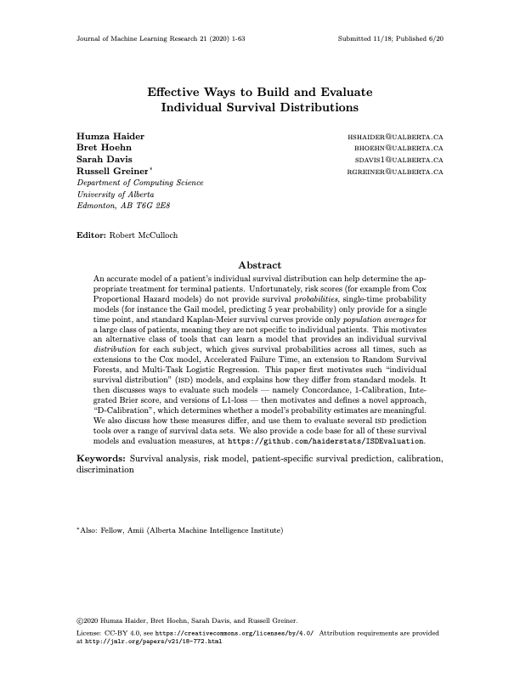
D-Calibration: An Effective Way to Evaluate Individual Survival Distributions
An accurate model of a patient’s individual survival distribution can help determine the appropriate treatment for terminal patients. Unfortunately, risk scores do not provide survival probabilities, single-time probability models only provide for a single time point, and standard Kaplan-Meier survival curves provide only population averages that are not specific to individual patients. This motivates an alternative class of tools that can learn a model that provides an individual survival distribution (ISD) for each subject, which gives survival probabilities across all times, such as extensions to the Cox model, Accelerated Failure Time, an extension to Random Survival Forests, and Multi-Task Logistic Regression. We motivate and define a novel evaluation approach, “D-Calibration”, which determines whether an ISD model’s probability estimates are meaningful. [GitHub]
Course projects
2021
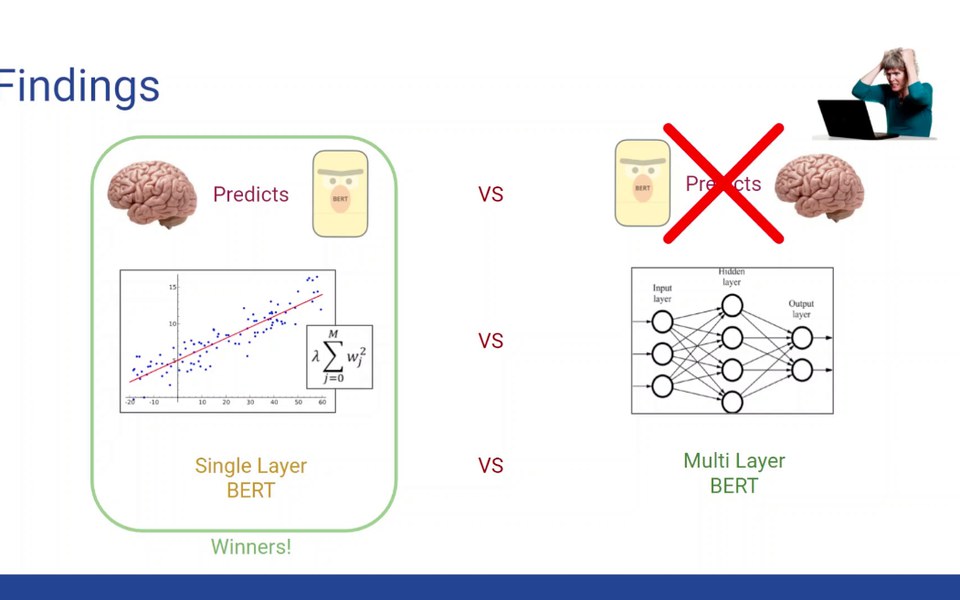
Are Multi-Layer BERT Features and EEG Representations of Words Correlated?
Here, we experiment to see if correlations exist between BERT representations and EEG brain-wave data for a given input sequence of words. Exploring the similarities and differences between machine learning and the brain can help inform the building of future ML architectures. As part of this project, we came up with sets of features based on combinations of BERT layer embeddings and trained different types of mapping models to see which are most correlated with EEG data. [GitHub]
2021
Exploring Stack Augmented Neural Networks for Transduction
It has long been known that augmenting a recurrent neural network with external memory can increase the complexity of patterns it can express. This extension is particularly interesting with respect to the transduction problem, which is described as the learning of a model that both accepts or rejects a string as being part of an input language, and subsequently translates it into another target language. In this work, we explore ways in which a Stack-RNN (SRNN) can be incorporated into a Seq2Seq model, with the end goal of creating an effective transduction pipeline. [GitHub]
2020
Describing Multi-Centered Spatial Events in Geo-Tagged Data Using Twitter COVID-19 Data
This project's aim is to improve upon existing methods for using coordinate data to localize events that have multiple centers. To accomplish this, we propose a framework that allows for greater flexibility in center localization compared to previous literature, then test our method on publically available geo-tagged Tweets. This work is especially important during the current pandemic, as understanding hot spots of COVID-19 infection is of particular societal interest. [GitHub]
2020
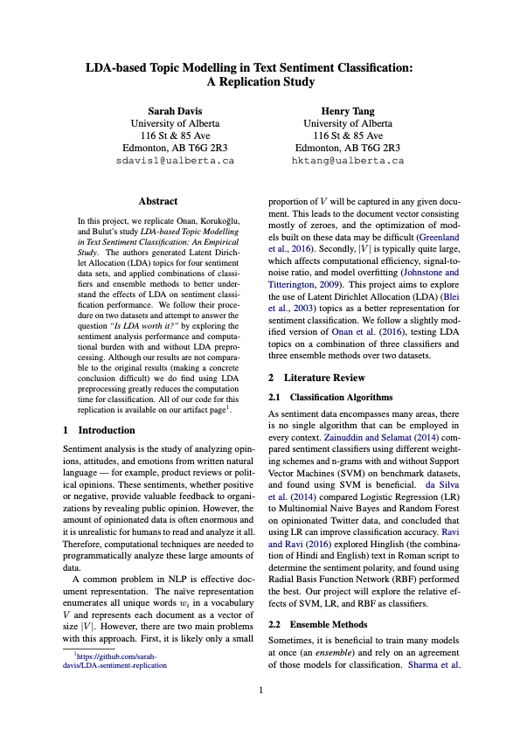
Evaluation of Latent Dirichlet Allocation Topic Modeling for Sentiment Analysis
Previous authors generated Latent Dirichlet Allocation (LDA) topics for four sentiment datasets, and applied combinations of classifiers and ensemble methods to better understand the effects of LDA on sentiment classification performance. We follow their procedure on two datasets and attempt to answer the question "Is LDA worth it?" by exploring the sentiment analysis performance and computational burden with and without LDA preprocessing, which was absent from the original publication. [GitHub]
2020
SHEST: Secular Heritability ESTimate
Heritability is the standard measure used to quantify the relative genetic contributions to various phenotypes, diseases, and conditions. However, heritability values derived from the two most popular estimation methods (namely, twin studies and GWAS) rarely agree. This discrepancy is called the missing heritability problem. In this project, we develop a novel approach to estimate heritability by assessing the magnitude of the secular trend in the incidence or prevalence of a specific phenotype or disease for a given population and compare our heritability values to those in literature.
Side projects
2021
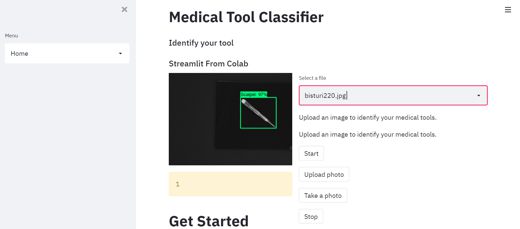
Medical Tool Image Classification
Every 1/1000 to 1/3000 abdominal operations result in incomplete retention of surgical tools — in other words, tweezers, scalpels, needles, sponges, towels, and more occasionally remain in patients after surgery. In this project, I lead a team of people responsible for the creation of the machine-learning part of a medical tool object-detection application. Downstream iterations of the model could one day act as another set of tool-counting “eyes” in the operating room. Please refer to the AIMSS official release to learn more. [GitHub]
2020
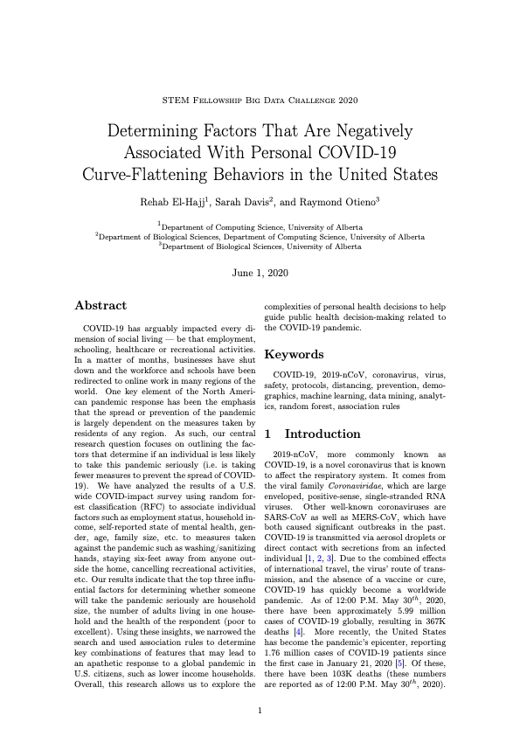
Modeling COVID-19 Curve Flattening Behavior in the United States
COVID-19 has arguably impacted every dimension of social living — be that employment, schooling, healthcare, or recreational activities. One key element of the North American pandemic response has been the emphasis that the spread or prevention of the pandemic is largely dependent on the measures taken by members of the general public. Our central research question focuses on outlining the socioeconomic, health, and demographic factors that are related to an individual avoiding personal measures that prevent the spread of COVID-19.
2019
Live-Video Organ Object Detection
This application was developed for the purpose of demonstrating AI (with a medical twist) to children aged 6-12. First, I created and labeled a large dataset of photos containing paper cutouts of organs, then used Tensorflow's Object Detection Library to tune a model to classify them. The application itself takes webcam feed as input and uses the model to predict which medical item appears in the video, draws a bounding box around it in every frame, and live-outputs the augmented video on the screen. This tool was demonstrated to over 200 children and family members.